Software Development Outsourcing Statistics and Trends (2026)
Last updated:
2026-05-30
7 min read
Business


Sofiia Yurkevska
Content Writer
%20(1).avif)
Contents
See more
Key software development outsourcing statistics on market size, costs, adoption and global trends. Up-to-date outsourcing data and insights from Freshcode.
Late 2022, ChatGPT goes public. By mid-2023, every board in the world is asking their CTO the same question: when are we doing AI? By late 2024, most of those CTOs had the same answer: we want to, but we don't have the people.
That's the story behind the software development outsourcing statistics for 2026. The global IT outsourcing market now sits somewhere between $564B and $744B depending on how you count it, projected to hit $1.22 trillion by 2030. Those are big numbers. But the more interesting number is 34% — the share of executives who still cite cost reduction as their primary reason for outsourcing, down from 70% in 2020. In four years, the entire rationale for one of the world's largest industries shifted and this is what the software development outsourcing market looks like after that change settled in.
Key Software Development Outsourcing Statistics (Top Highlights)
Before diving into the details, here are the most significant key outsourcing statistics shaping the landscape in 2026:

Global Software Outsourcing Market Statistics
To understand where this market is in 2026, it helps to remember where it was in 2023.
Three years ago, outsourcing articles were full of the same statistics, the same justifications, and the same projections: cost savings, digital transformation, cloud migration, etc. The numbers were slightly smaller but the narrative was almost identical, because the real shift was just beginning.
In 2023, the IT outsourcing market was valued at around $480B. (Hire With Near) Today it's closer to $564B–$744B depending on scope, and the composition of what's being outsourced is almost unrecognizable from that earlier period. Back then, the dominant outsourcing categories were infrastructure management, application maintenance, and helpdesk. Today, the fastest-growing segment is application development at 37.85% of total ITO spend. And the reason it's growing is that businesses discovered, largely through the AI scramble of 2023–2024, that their existing systems weren't built to integrate anything new. The legacy backend that ran fine for a decade suddenly became the blocker for every AI initiative on the roadmap.
That's why "platform engineering" went from a niche DevOps concept to a mainstream outsourcing service category almost overnight. When AI requires every system to talk to every other system in real time, you need the infrastructure to support that. Most companies didn't have it. Most still don't have the internal teams to build it. Hence the market.
The table below compares estimates from major research firms, illustrating the range of projections depending on scope:
*ISG Index tracks large-contract ($5M+) managed services only; not comparable to total market estimates.
Market Revenue, Growth Projections and Spending Statistics
90% of businesses now identify Cloud as the primary driver of their outsourcing decisions. (Deloitte) That sounds like a lot until you remember that cloud was already the most hyped technology category of 2014–2017, when every enterprise presentation included a migration roadmap and every CIO had a "cloud-first" mandate.
Cloud went from aspiration to operating infrastructure for most large businesses over that decade. What changed in 2025 is why it's driving outsourcing decisions. The reason went from "we need to migrate off on-premise servers." to "we're on cloud, our AI tools need cloud-native architecture to function, and we need engineers who can build and maintain that at scale." The requirement got more sophisticated while the internal teams largely didn't.
Software Development Outsourcing Adoption Statistics
Here's a useful way to think about who is outsourcing and why.
Imagine a CTO at a mid-size retail chain. Say, 200 employees, a legacy backend running the inventory system, and a board that wants an AI-powered demand forecasting tool by Q3. The dev team is eight people, fully committed to keeping the existing systems running. the CTO has three options: hire the AI/ML engineers needed (average time to fill: four to six months, if she can find them), delay the AI project, or bring in an external team with the expertise to build it without pulling the core team off existing commitments. In 2020, option three was a last resort. In 2026, it's the first call.
That's the story behind the adoption numbers.
Business Adoption Rates by Company Size
Staff Augmentation vs Full Project Outsourcing Statistics
The shift from "outsource a project" to "outsource a capability" is the most structurally important change in how this market operates.
In 2023, project-based outsourcing was still the default mental model: define a scope, hand it to a vendor, review the output. That model still exists (and it's growing at 8.12% CAGR, driven by discrete initiatives like ERP migrations). (Mordor Intelligence) But it's being overtaken by managed services (45.93% of the total market), where external teams own a function or capability on an ongoing basis, and staff augmentation, where external engineers sit inside your sprint cycles and attend your standups.
The reason for the shift is that AI and cloud projects don't have clean endpoints. You don't build an AI demand forecasting model, hand it over, and walk away. You build it, monitor it, retrain it, integrate it with three other systems, and iterate on it for two years. And that requires a team.
Industry-Specific Outsourcing Trends
Outsourcing demand is not evenly distributed across industries. Financial companies (through the BFSI sector) lead with 25.18% of global IT outsourcing spend, concentrating on core banking, cybersecurity, and compliance. Healthcare IT outsourcing is growing at 5.46% CAGR, driven by telehealth platform development, AI-assisted diagnostics, and HIPAA compliance requirements. Retail and e-commerce are expanding rapidly by building real-time inventory systems, recommendation engines, and logistics platforms that require ongoing engineering capacity most retailers can't maintain in-house. Manufacturing and government show stable activity focused on infrastructure and cybersecurity.
Cost and ROI Software Outsourcing Statistics
The 40–70% cost saving figure (Deloitte) is real but it flattens a decision that's considerably more nuanced. Here's what the regional data shows when you put everything in comparable annual terms:
(Accelerance 2025 Guide / DistantJob / Voidweb)
The India vs. Eastern Europe comparison is worth unpacking specifically. India offers the lowest entry point — rates of $15–$50/hr, a talent pool of nearly 6 million developers, and unmatched scalability. Eastern Europe typically costs 2–3x more per hour, but delivers narrower time-zone overlap with EU clients (1–3 hours vs. India's near-zero), stronger regulatory comfort for GDPR-sensitive projects, and a more consultative working style that reduces management overhead. On a complex $500K project, that overhead difference can easily exceed the headline rate gap. The right choice depends on your project's complexity, required collaboration intensity, and regulatory context. (Voidweb / Engineer Babu)
Productivity and Time-to-Market Statistics
The cost comparison above is already becoming outdated, because it assumes a human-only productivity baseline.
What this means in practice: an outsourced team using AI-assisted development is not only cheaper than an equivalent in-house team, but can also be faster. The ROI conversation has shifted from "how much do we save?" to "how much more can we ship?"
87% of North American engineering leaders are already funding GenAI pilots through their outsourcing partners in 2025. (Mordor Intelligence) When evaluating providers, asking about their AI tooling and workflow is now a legitimate part of due diligence.
Software Developer Talent Shortage Statistics Driving Outsourcing
Go back to the CTO at the retail chain. They are outsourcing because there are 1.4 million unfilled IT positions in the US alone where in a total tech workforce of approximately 4.5 million. (Mordor Intelligence / Zippia) That's a vacancy rate of over 30%. They are not going to win a hiring competition for AI/ML engineers against Google, and they shouldn't have to.

The optimistic read on these numbers is that in 2023, the conversation was mostly about a general developer shortage. The more specific and harder-to-solve shortage in 2026 is specialized skills: AI/ML, cloud-native architecture, cybersecurity, and platform engineering. These are gaps that take years to close domestically, which is exactly why 74% of employers keep reporting they can't fill the roles.
Software Outsourcing Risks and Challenges Statistics
A complete picture of outsourcing software development statistics also includes the challenges. Understanding failure patterns is as important as understanding the opportunity.
70% of companies have brought previously outsourced work back in-house over the past five years. (DOIT Software) Only 54% of outsourcing clients report that quality meets or exceeds their internal benchmark. (Deloitte) And the most telling number: 55% of organizations can't accurately measure what their outsourcing is actually delivering. (Deloitte)
That last one explains most of the failures. Companies can't manage what they can't measure. When the engagement starts with vague success criteria like "build us a platform," "support our dev team," "help us move to cloud", there's no mechanism to know whether it's working until something goes obviously wrong. By then, the instinct is to pull the work back in-house and call outsourcing a failed experiment. The problem usually wasn't the model. It was the absence of defined outcomes, measurable KPIs, and regular governance checkpoints.
63% of companies also cite data security as a top outsourcing risk. (Mordor Intelligence) This one is legitimate and worth taking seriously, particularly when engaging providers in jurisdictions with weaker regulatory frameworks, or when the work involves customer data, financial systems, or healthcare records.
The companies that get outsourcing right tend to do three things differently:
Software Development Outsourcing Trends Statistics
Staff Augmentation Growth Statistics
Flexible engagement models are growing faster than traditional project-based outsourcing, reflecting the need for companies to scale teams dynamically and focus internal teams on core business functions rather than commodity work:
AI and Emerging Technology Outsourcing Statistics
Technological advancements are reshaping what the outsourcing sector delivers and how it's priced:
Future Software Outsourcing Trends and Forecasts
Looking ahead, several structural market trends are reshaping global software development outsourcing:
What Software Development Outsourcing Statistics Mean for Businesses
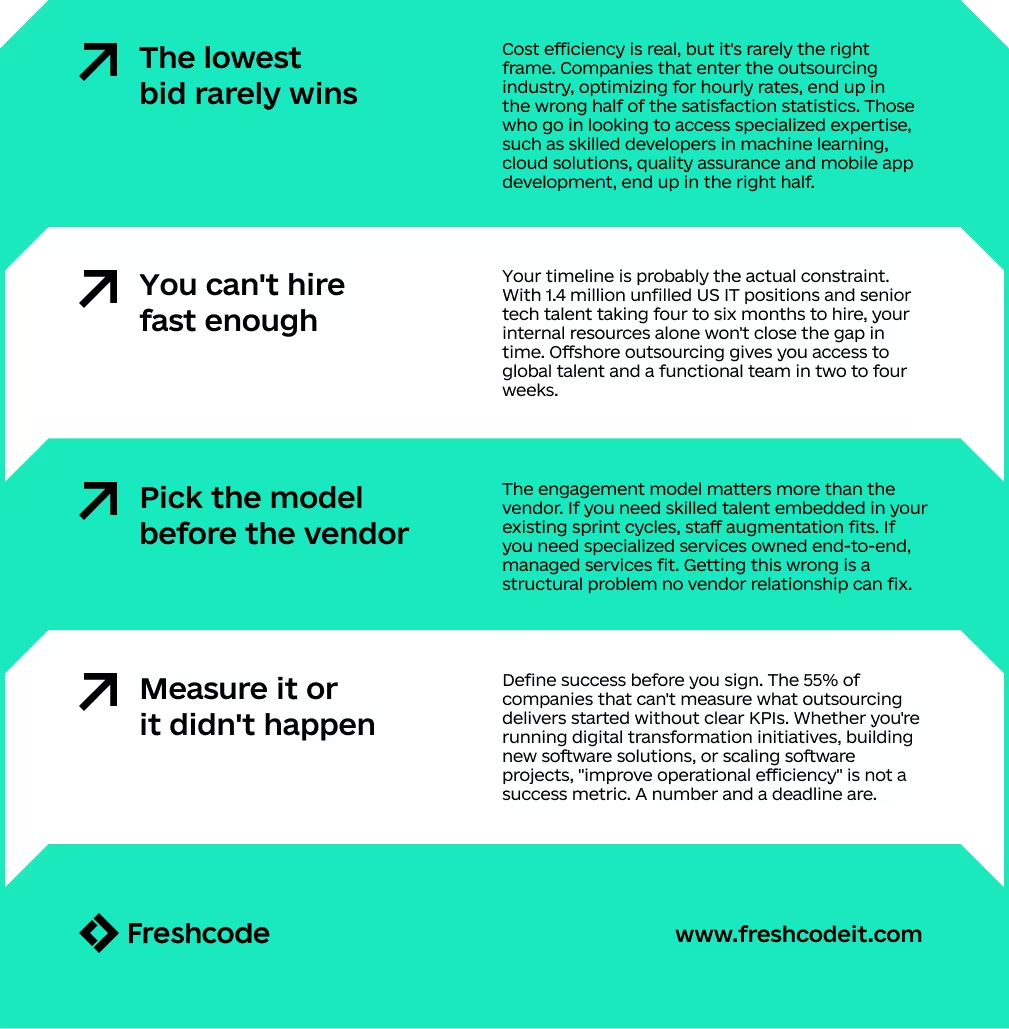
The numbers above describe a market. Here's what they mean for the decision in front of you.
Conclusion
In 2023, the outsourcing conversation was about cost. In 2026, it's about whether your roadmap moves or stalls. The talent gap isn't closing, the AI skill shortage is getting more specific, and the companies building things are mostly doing it with global teams.
If you're evaluating where you stand, Freshcode's Software Development Services and Staff Augmentation are a good place to start.

with Freshcode